
EV Charger Deployment Errors:
Common Mistakes, Identification, and Avoidance Guide
In EV Charger installation projects, the deployment phase is often a high-incidence period for faults. Based on end-user feedback, 80% of charging station issues arise from simple oversights rather than the equipment itself. This article draws from real client experiences to systematically break down deployment errors, helping you sidestep potential risks.
What Are EV Charger Deployment Errors?
EV Charger deployment errors refer to oversights in installation that ignore standard norms, leading to reduced charging efficiency, safety hazards, or premature equipment failure. These are common in rushed projects or with inexperienced teams. Example: Clients complain, “The charging station trips frequently after setup”—often due to improper cable selection causing overloads.
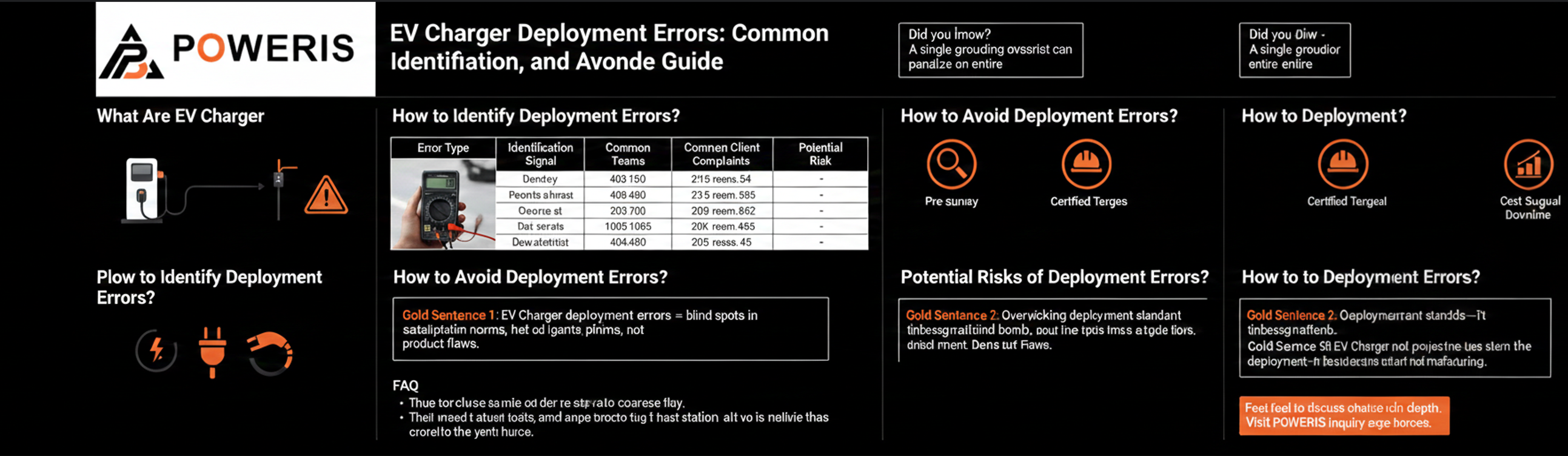
How to Identify Deployment Errors? During on-site inspections, focus on these indicators:
- Grounding and Leakage Protection: Test grounding resistance (should be <4Ω); if >10Ω, it risks leakage.
- Ventilation and Heat Dissipation: Ensure >50cm clearance around the charger; overheating is a key failure signal.
- Cable and Compatibility: Verify cross-sectional area matches power (e.g., 22kW needs at least 6mm²); mismatch can cause 20%+ efficiency drop。
| Error Type | Identification Signal | Common Client Complaints |
|---|---|---|
| Poor Grounding | Abnormal resistance test | “Tingling sensation during charge” |
| Inadequate Ventilation | Device temperature >60°C | “Slow or shutdown in summer” |
| Cable Mismatch | Voltage drop >5% | “Trips under full load” |
| IP Protection Overlooked | Signs of water ingress | “Short circuit in rain” |
How to Avoid Deployment Errors? Adhere to IEC 61851 standards, combined with local grid requirements (updated in 2026 UK regs for cybersecurity and off-peak charging):
- Pre-survey the site: Assess environment (indoor/outdoor) and select appropriate IP rating (e.g., outdoor at least IP65).
- Use certified teams: Avoid DIY with professional installers.
- Iterative testing: Simulate full-load operation for 24 hours post-install, monitoring parameters.
Potential Risks of Deployment Errors,Ignoring these pitfalls can lead to:
- Safety incidents: Poor grounding causes shocks or fires (EU CPO data shows 30% of failures from this).
- Cost surges: Rework fees up to 50% of initial investment.
- Operational downtime: Efficiency drops leading to user churn.
FAQ
- Q: How do deployment errors affect charging efficiency? A: Can cause 15-30% decay due to overheating or compatibility issues.
- Q: Suitable for which scenarios? A: Ideal for fleet operators or property charging stations to avoid business losses.
Feel free to discuss your project challenges in depth with POWERIS TEAM.