
EV Charger Energy Efficiency Blind Spots 2026: 8 Causes & Fixes | POWERIS
Your 350kW ultra-fast charger station is running—but electricity bills are 30-50% higher than expected, heat dissipation eating power, and actual efficiency far below rated. In 2026, with ultra-fast charging adoption, V2G rollout, and AI energy management, energy efficiency blind spots are the hidden cost killer. From real CPO and fleet operator reports in Europe/Netherlands, 20-40% efficiency loss is preventable. This guide maps 8 common blind spots and real fixes to save 20-40% on power costs.
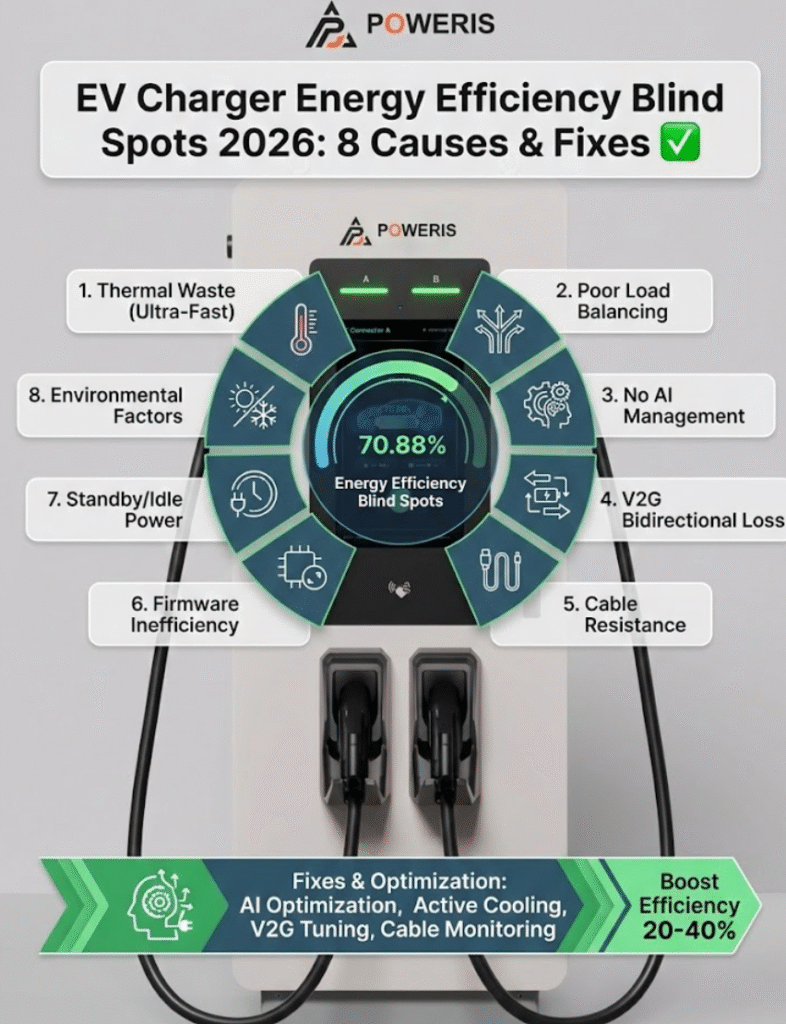
What Are Energy Efficiency Blind Spots in EV Chargers?
Energy efficiency blind spots are overlooked factors causing power loss during charging—thermal waste, poor load balancing, firmware gaps—now amplified by 2026 ultra-fast (350kW+) and V2G trends. Common client complaint: “Rated 95% efficiency, but real bills show 70-80%”—often from heat loss in high-current sessions or no AI optimization.
How to Identify Energy Efficiency Issues?
Track these signals:
- High electricity variance: Bills spike 30%+ in peak months.
- Excessive heat: Charger body >65°C during 150kW+ sessions.
- Low real vs rated efficiency: Meter shows 70-85% vs claimed 95%.
Table: 8 Common Energy Efficiency Blind Spots in 2026:
| # | Blind Spot | 2026 Trigger Trend | Efficiency Loss Impact | Early Warning Sign |
|---|---|---|---|---|
| 1 | Thermal waste in ultra-fast | 350kW+ high-current charging | 15-25% | Sustained temp >65°C |
| 2 | Poor load balancing | Multiple vehicles peak load | 10-20% | Uneven power distribution |
| 3 | No AI energy management | AI optimization not implemented | 10-30% | No real-time power adjustment |
| 4 | V2G bidirectional loss | V2G rollout without tuning | 8-18% | Higher grid draw during discharge |
| 5 | Cable resistance & length | Long cables in large stations | 5-15% | Voltage drop >5% at vehicle end |
| 6 | Firmware inefficiency | Outdated OCPP/AI firmware | 5-12% | No OTA updates in 6 months |
| 7 | Standby/idle power waste | 24/7 idle consumption | 3-10% | High baseline meter reading |
| 8 | Environmental heat/cooling | Poor ventilation in hot/cold | 5-20% | Seasonal efficiency drops |
Leverage current trends:
- AI energy management: Implement AI load balancing to reduce waste 20-40%.
- Active cooling upgrades: Add fans/liquid cooling for ultra-fast stations.
- V2G tuning: Optimize bidirectional efficiency with OCPP 2.0.1.
- Short cable runs & monitoring: Minimize resistance, use real-time power meters.
FAQ
- Q: What’s realistic efficiency for 350kW ultra-fast chargers in 2026?
- A: 85-92% with AI cooling; 70-80% without optimization.
- Q: How does V2G affect energy efficiency?
- A: Adds 8-18% loss if not tuned; proper setup can achieve near-neutral loss.
Share your station’s actual vs rated efficiency or AI optimization results with POWERIS to get discuss.